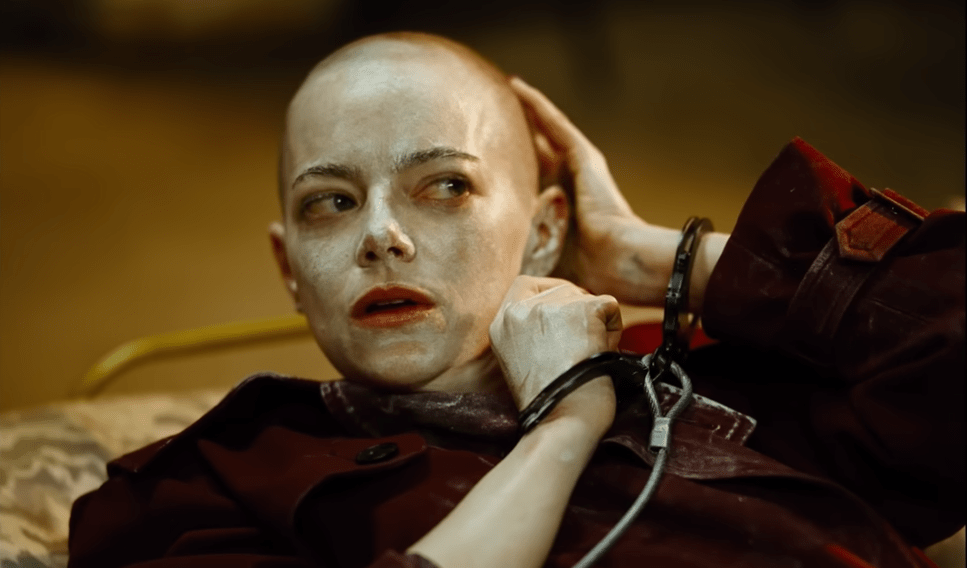
There’s a moment in Bugonia, Yorgos Lanthimos’s new fever-dream satire, when you’re not sure whether to laugh, recoil, or both. A woman, played by Emma Stone, sits bald-headed under fluorescent light, tied to a chair, while her captor calmly explains that she’s an alien. Around them, bees hum in glass jars. The scene is funny, horrifying, and heartbreakingly sad all at once, which is to say, it’s pure Lanthimos.
The Greek filmmaker has spent the past decade redefining modern cinema, turning the absurd into art and the grotesque into something strangely human. After The Favourite and Poor Things, both with Stone, Bugonia feels like the logical next step, and the most daring one yet. It begins as a darkly comic kidnapping thriller and ends as an apocalyptic parable about faith, fear, and the crumbling world we’ve built.
A Conspiracy, a Kidnapping, and an Idea That’s Just Crazy Enough to Work
The setup sounds simple enough, until it isn’t. Jesse Plemons plays Teddy, a mild-mannered man convinced that the CEO of a global tech-pharma company, Michelle Fuller (Emma Stone), is not human. He’s certain she’s part of an alien race plotting to enslave humanity, and he’s determined to save the world, one abduction at a time.
With the reluctant help of his cousin Don (Aidan Delbis), Teddy kidnaps Michelle and drags her to his basement “laboratory,” a tinfoil-lined bunker decorated with hand-drawn charts and jars of buzzing bees. What follows is a strange interrogation that feels equal parts sci-fi experiment and therapy session. Michelle denies everything. Teddy doubles down. And slowly, unsettlingly, the question forms: what if he’s right?
From there, the film spirals outward into corporate satire, environmental allegory, and psychological horror. As lunar eclipses darken the sky and bees begin to die off in the fields outside, Bugonia turns into a kaleidoscope of paranoia and poetic imagery. The further we go, the less certain we are of anything, and that’s exactly the point.
The Real Monsters Among Us
At first glance, Bugonia plays like a twisted cousin to Get Out or Donnie Darko, a genre film with sharp teeth. But beneath the madness, Lanthimos is probing something deeper: our collective hunger for meaning in a chaotic world.
Teddy’s obsession isn’t just about aliens. It’s about power: who has it, and how it makes the rest of us feel small. Michelle Fuller, sleek and self-assured, represents the kind of corporate authority that seems untouchable. To someone like Teddy, she might as well be from another planet. When you live in a world where billion-dollar decisions are made behind screens, believing your boss is an alien doesn’t sound so crazy.
Then there’s the bees. Teddy keeps hives in his backyard, fussing over them like children. To him, they’re symbols of purity and order, a world that makes sense. But as the film unfolds, the metaphor stings. The hive, the workers, the queen, it’s all just another system of control. Maybe humanity isn’t so different from the insects we exploit.
Lanthimos has always been fascinated by control. How people enforce it, surrender it, or pretend it doesn’t exist. In The Lobster, love was a government mandate. In The Favourite, it was a game of political seduction. In Bugonia, it’s belief itself: the stories we tell to make sense of a world that’s slipping away.
Stone, Plemons, and the Art of Unraveling
Emma Stone continues to prove she’s one of the boldest performers of her generation. As Michelle Fuller, she begins the film with polished confidence, the perfect face of corporate serenity. But stripped of her hair, power, and dignity, she reveals layer after layer of raw humanity. There’s a strange empathy in her performance, even when she’s terrifying. You can never tell if she’s breaking down or playing along.
Jesse Plemons, meanwhile, delivers a quiet storm of a performance. His Teddy is not a cartoon conspiracy theorist but a man trying desperately to understand a world that no longer makes sense. His calmness makes him scarier than rage ever could. Watching him “prove” his theories, with makeshift gadgets and manic conviction, feels uncomfortably real in an age when misinformation has become its own religion.
Together, Stone and Plemons create a volatile chemistry that drives the film. Their scenes are like duels – shifting, tense, intimate, and unpredictable. You start wondering who’s manipulating whom, and by the end, you’re not sure either of them is human anymore.
Lanthimos’s World of Controlled Chaos
Visually, Bugonia is a masterclass in contrast. Lanthimos and cinematographer Robbie Ryan shot the film on 35mm, giving it a lush, tactile feel. The lighting is natural but uncanny: Daylight that feels too white, darkness that feels too deep.
The film moves between sterile corporate towers and the grimy warmth of Teddy’s basement, between sleek surfaces and sticky honey. Every frame is deliberate, every composition slightly off-kilter. The camera lingers where most filmmakers would cut away, forcing us to sit in discomfort.
As the story progresses, the imagery becomes increasingly surreal. Beehives split open to reveal mechanical innards. Michelle’s dreams bleed into waking life. The film’s climax unfolds like a hallucination: part body horror, part cosmic revelation. It’s a descent into madness shot with painterly precision.
Yet amid the chaos, Lanthimos maintains his signature dark humor. A scene involving a malfunctioning lie-detector helmet is both hilarious and horrifying. His films have always walked that fine line between absurdity and truth. The moment where laughter catches in your throat because it’s too close to home.
Ambiguity as Art
Like most of Lanthimos’s work, Bugonia refuses easy answers. Is Michelle really an alien? Are Teddy’s theories delusions or glimpses of a terrifying truth? The film flirts with both possibilities, then dissolves them in ambiguity.
That’s what makes it linger. You don’t leave Bugonia with a sense of closure; you leave with a quiet unease that hums under your skin. It’s a film about belief, not in aliens, but in ourselves, in the systems we build, in the lies we need to keep functioning.
For Lanthimos, belief itself is the ultimate horror story.
The Third Collaboration
Bugonia marks the third collaboration between Lanthimos and Stone, following The Favourite and Poor Things, and by now they seem to speak a private cinematic language. He pushes her into stranger, riskier territory each time, and she rises to the challenge. What’s fascinating is how different this performance feels. Stripped of the ornate costumes and fantasy worlds of their previous work, Stone becomes something more primal. She’s less goddess than ghost, haunting the frame.
The film also introduces a striking new dynamic with Jesse Plemons, whose grounded intensity complements Stone’s controlled volatility. Their performances never overpower Lanthimos’s distinct tone. Instead, they merge into it, creating something both intimate and alien.
What Bugonia Says About Us
For all its surreal flourishes, Bugonia might be Lanthimos’s most relevant film yet. Beneath the talk of aliens and bees lies a story about humanity’s current state of paranoia. About how people, overwhelmed by inequality, technology, and climate dread, cling to conspiracy because it gives them a sense of agency.
In that way, Teddy isn’t a villain so much as a tragic reflection of the times. His madness is the logical outcome of a culture drowning in information but starving for truth. Michelle, on the other hand, represents the cold machinery of modern power: rational, efficient, and quietly devastating.
When their worlds collide, the result is both explosive and eerily tender. In the end, Bugonia isn’t really about whether aliens exist. It’s about how far we’ll go to believe that they do. Because the alternative, that we’re destroying ourselves all on our own, is too unbearable to face.
A Beautiful, Terrifying Achievement
Bugonia isn’t easy viewing. It’s messy, intense, and occasionally baffling. But it’s also alive. It’s pulsing with ideas, contradictions, and moments of pure cinematic magic. It’s the kind of film that reminds you how rare true originality has become.
Lanthimos has made a career of confronting audiences with discomfort, and Bugonia continues that tradition with unflinching purpose. It’s a story about faith and fear, control and chaos, humanity and the inhuman. It makes you laugh when you should cry, and think when you want to look away.
By the time the final image fades, one question remains: who are the real aliens? The ones watching from above, or the ones we see in the mirror?